
When Prior Knowledge Helps, and When It Doesn’t
Four basic considerations and the one that should come first

Prior knowledge is essential for learning. Most teachers know this. But to make the idea genuinely useful, we need to ask more precise questions: through which mechanisms does prior knowledge shape learning, and which of these mechanisms should we consider first? After all, prior knowledge does not simply “help” learning - it can help, hinder, or make little difference, depending on how it interacts with new ideas.
As an analogy, we can say that flour is essential for baking. Yet it can also hinder the process if, for example, it is used without opening the package, used in the wrong amount, mixed improperly, or added at the wrong time.
To make prior knowledge useful for teaching, we should look at what the scientific literature tells us about its relationship with learning, which factors matter most, and how they interact. On this basis, it’s our job to consider how teachers might organise them into a useful way of making decisions. That is the plan for this post. Let’s go.
An enlightening meta-analysis by Simonsmeier (2022) explores in depth the relation between prior knowledge and learning. They arrive at a complex and somewhat surprising conclusion: while prior knowledge strongly predicts future knowledge, it does not necessarily predict knowledge gain (which measures learning). Looking deeper into the data they show a range of effects, some quite positive and some similarly strong but negative, and all the range in between. In other words, they show that prior knowledge can help, hinder or not change learning, and they call it ‘the prior knowledge paradox’.
Diving deeper, there are many possible explanations. The authors suggest that this is probably due to a large number of mediating factors with different effects. In a later publication (Schneider & Simonsmeier, 2025), they review evidence of 16 such possible mediators (e.g. attention, encoding, comprehension, retrieval, interference, motivation, and transfer) in an attempt to explain the “prior knowledge paradox”. But is it really a paradox?
Brod (2021), in his comment on this meta-analysis, suggests a more concise way forward by highlighting the underlying mechanisms by which prior knowledge affects learning. Brod identifies three main sequentially dependent factors and suggests that to know whether prior knowledge helps or hinders learning, we must ask whether it is active, relevant, and congruent (see fig. 1 in Brod, 2021). This approach makes a lot of sense for researchers and teachers alike. Other scholars take a similar approach: Ambrose et al., (2010) suggest that prior knowledge helps learning only when it is activated, sufficient, appropriate, and accurate. McNamara and McCarthy (2021), in their framework of Multidimensional Knowledge in Text Comprehension, suggest four interrelated essential dimensions of prior knowledge: amount, accuracy, specificity, and coherence.
What do teachers need to take into consideration?
While many parameters surely mediate the effect of prior knowledge on learning, understanding all the relations among them when making decisions is certainly overwhelming. An approach that highlights the main mechanisms is more effective. So what are the essential mechanisms, and what is the best way to think about them when planning a learning sequence?
As described above, Brod (2021) suggests that we should consider activity, relevance, and congruency in that order, while McNamara and McCarthy (2021) suggest that amount, accuracy, specificity, and coherence should be considered in parallel. Their suggestions are mainly aimed at researchers (though reading them is highly recommended for anyone interested in the evidence). Here is a teacher-oriented sequence:
Prior knowledge is essential for learning
We start with this widely accepted assumption: when we learn, we process incoming information using whatever we have stored in memory - our prior knowledge. Learning is considered successful when we:
Focus on the most relevant incoming information and represent it in our mind
Activate the most relevant existing knowledge representations
And, bind them together in a way that reorganises these representations.
This processing is what we call working memory (as explained in this post) - and it determines what we remember afterwards.
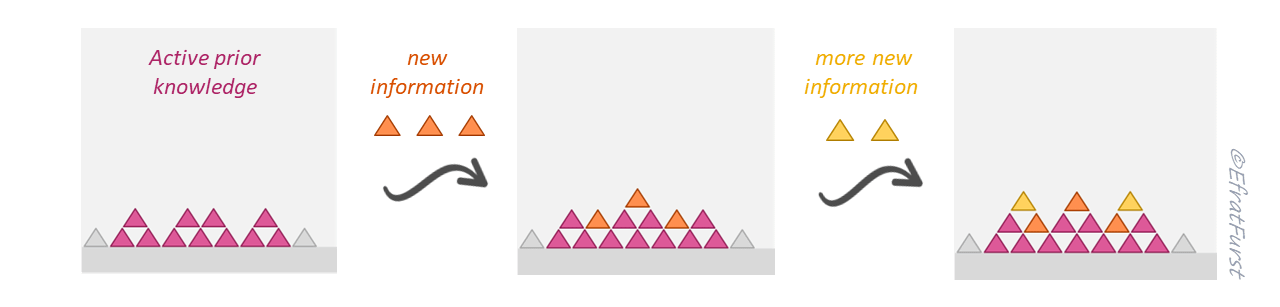
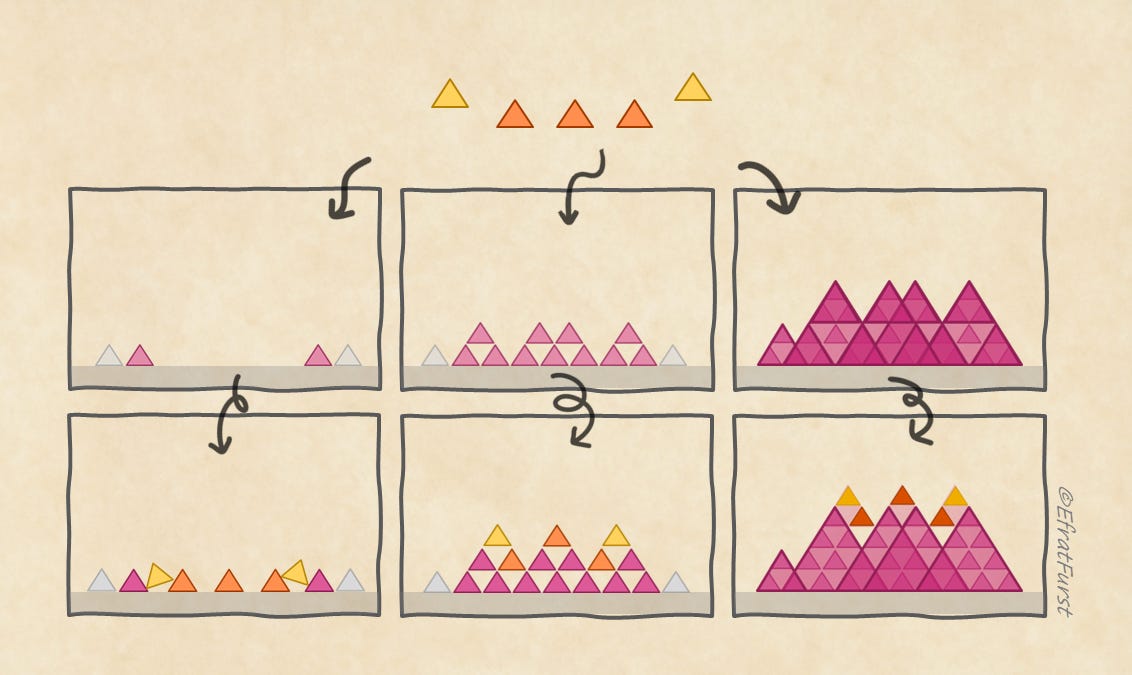
To illustrate it, if we are learning some new ideas (orange and yellow blocks) based on prior knowledge (magenta), we can create a new construct:
Learning the same but without relevant prior knowledge will likely look like this:
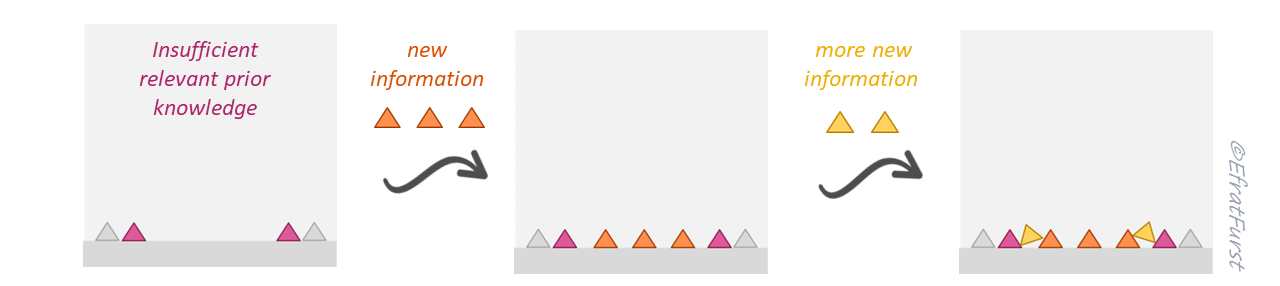
The illustration makes this assumption concrete: prior knowledge is not just something that helps learning. It is the material that learning works with. New information becomes meaningful when it binds with something already stored in memory.
Moreover, this process highlights the mechanism that leads to the change: only existing, relevant, active prior knowledge can bind with new information to create a meaningful construct.
Last, we see that to consider these mechanism of the construrction process, we need to start by knowing what we want to contruct.
Start with the goal
To build a pyramid or a conceptual understanding, we need to identify the elements and how they are organised: what’s new and on what previous layer it builds.
Every discussion of prior knowledge is theoretical unless the desired outcome or goal is determined in advance. Notably, we cannot even talk about relevancy, specificity, and accuracy independently of the expected outcome. For example, one may have stored “Sydney is the capital of Australia” in memory - this may be inaccurate if the relevant knowledge is about capitals, but relevant and accurate if the goal is to infer the country from the mention of the city.
So we have two basic assumptions: A) Prior knowledge is essential and B) We have a specific goal.
When these are in place, what are the considerations for structuring learning from A to B? The models above highlight that for prior knowledge to support learning, it must be:
Active
Relevant, specific, or appropriate
Accurate
And another factor that is described in different ways - sufficient, coherent and congruent - all of which hint at the structure of the prior knowledge. I suggest this is the most important factor and should be considered first, because it dictates the other considerations and decisions made by teachers:
Prior knowledge structure - shallow or deep?
In a previous post, I used the pyramid model to demonstrate the qualitative difference between handling well-cemented, highly practised structures of knowledge versus newly built structures in working memory. The same logic applies here, since we are focusing on prior knowledge as it functions in working memory at the time of learning.
We often distinguish these knowledge structures as deep vs. shallow (or surface level) (e.g. Willingham, 2003), where:
Deep means multiple interconnected concepts, well organised into larger, practised structures (on the right below).
Shallow means sparse, newly learned concepts, not yet well organised or practised.
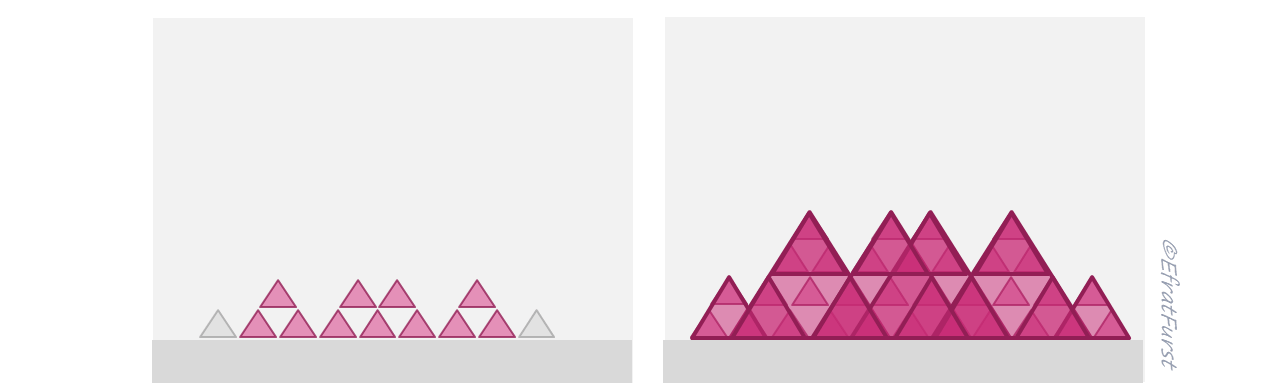
The “depth” of prior knowledge changes how we should think about the other mechanisms: activation, relevance, and accuracy.
Deep knowledge is often easily activated by a short, focused prompt, while shallow knowledge usually depends on the guidance of attention, and explicit step-by-step cues or prompts.
When it comes to inaccurate knowledge, on the other hand, shallow inaccurate prior knowledge can be fixed quite easily, while inaccurate deep prior knowledge is often resistant to change and calls for specific and effortful interventions.
Therefore, whether the prior knowledge is shallow or deep, it dramatically changes our choices regarding strategies of guidance and support.
When prior knowledge is shallow
When prior knowledge is shallow, we only have a surface layer of facts and ideas - not well connected or organised, and crucially, not practised. It might be what was learned in the last lesson, or even a year ago, without much depth.
When we encounter such concepts as learners, we may recognise them as familiar but struggle to recall the exact meaning, and be unsure of how and when to use them.
Therefore, as teachers, it is our responsibility to plan an activity that would:
Focus attention and activate prior knowledge, step by step if needed
Make sure that the relevant part is activated (and not remotely related associations that may interfere)
Check for accuracy in the context
Connect properly and meaningfully to the new idea we are teaching:
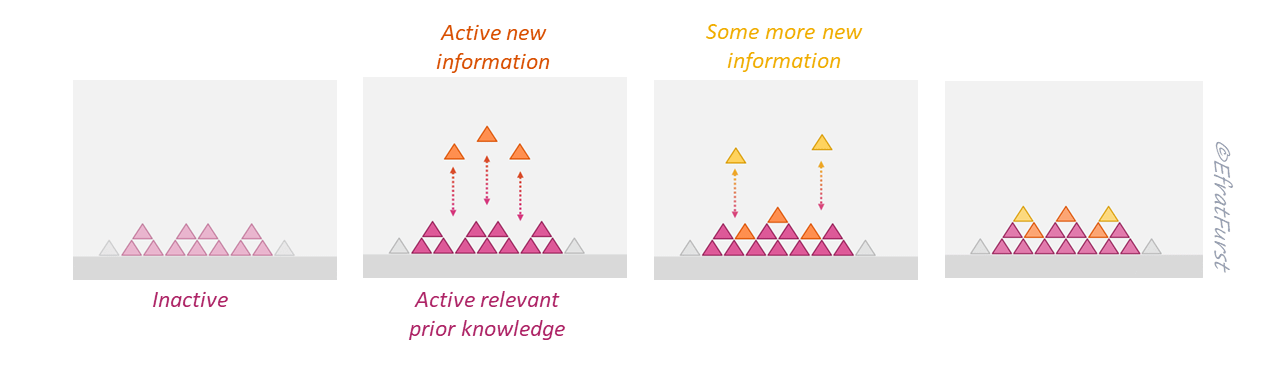
Each step is essential for acquiring the intended new meaningful construct. Otherwise, we risk a collection of unconnected pieces that may interfere with new learning, be encoded by rote, or not encoded at all.
So we know that if the prior shallow knowledge is activated, relevant, and accurate, it has a chance to help learning. But in any other case, it may not help and may even interfere with it.
Classroom activities such as explicit or direct instruction, purposefully planned around these steps, are known to be very effective for novice learners: they include guided retrieval questions on relevant prior knowledge with feedback, explicit explanations, sequenced examples, checks for understanding, and guided practice of every step.
Such activities provide an important opportunity to check for accuracy and act on it. Luckily, inaccurate shallow prior knowledge is still malleable and can be changed quickly with focused explanations and feedback.
However, this is not the case when prior knowledge is deep:
When prior knowledge is deep
When the relevant prior knowledge is deep, our challenges are very different. We can count on quick and efficient independent activation - we can say a sentence and assume our learners know what we are talking about. We do it all the time: for any given audience, we can rely on vocabulary, world knowledge, and subject-specific knowledge without needing dedicated activation activities. A clear, accurate introduction suffices, and learners can be reasonably trusted to activate the relevant information themselves.
The professional challenge for a teacher in this case is handling inaccurate deep prior knowledge. The semantics of inaccuracy actually help make this point very well:
When shallow prior knowledge is inaccurate, it is a mistake, and can be corrected with an accurate correction - a fresh “take”.
When deep prior knowledge is inaccurate, it is a misconception. We need to reconstruct an entire well-established structure, and this is much more difficult because conceptions are resistant to change.
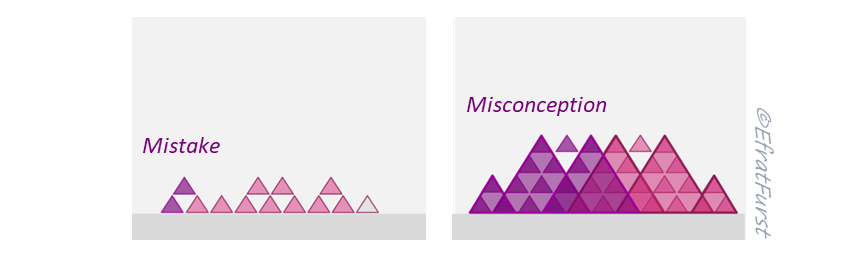
To do this, as the visuals help illustrate, we need to deconstruct substantial parts of an already solid structure and rebuild it. This is difficult because the established, cemented chunks are the result of repeated activation with affirming feedback.
It’s not just a lot of work - it’s work that learners are wired against. These are the structures that create the famous confirmation bias, which makes it easier for us to pay attention, process, learn, and remember ideas that are congruent with what we already know.
As learners in these situations, we actually predict what is going to happen and behave accordingly - and we do it with high certainty when our prior knowledge is solid and deep. Research on prediction reveals that we can use this same mechanism to learn something new. It turns out that the surprise from a prediction error is a powerful mechanism that allows us to learn something new, by enhancing attention, curiosity, and memory (Gruber and Ranganath, 2019, and also this blog about prediction in learning).
Thus, as teachers, we can intentionally plan a prediction activity around an expected misconception - specifically planning for those surprising moments when learners discover their misconceptions and may be curious enough to learn something new. To consolidate the new learning, additional repetitions will be needed until the new conception becomes the default one. This is clearly more challenging than correcting a surface-level mistake.
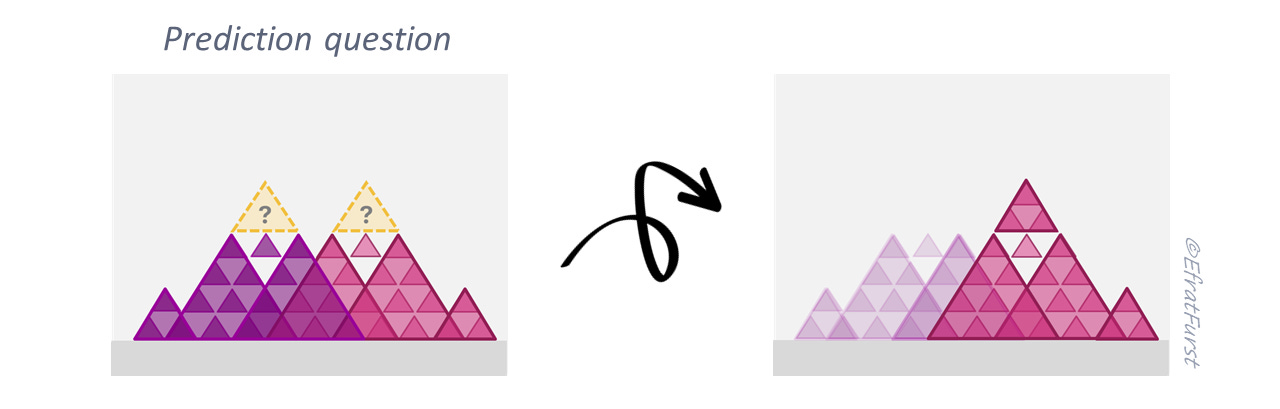
To summarize,
Ausubel famously argued that the most important single factor influencing learning is what the learner already knows. This remains probably the strongest starting point for teaching. But to make this idea even more useful, we ask a more precise question.
It is not only what learners already know. It is also how that knowledge is structured.
After the learning goal is clear, the depth of the relevant prior knowledge should be the first thing we consider. Shallow prior knowledge may need careful activation, guidance, checking, and connection. Deep prior knowledge may allow for quick and easy reactivation without assistance. But the approach flips when it comes to inaccurate prior knowledge - while shallow mistakes may be corrected with relative ease, deeper misconceptions require something much more demanding: prediction, surprise, reconstruction, and repeated practice until a new structure becomes stable.
References
Simonsmeier, B. A., Flaig, M., Deiglmayr, A., Schalk, L., & Schneider, M. (2022). Domain-specific prior knowledge and learning: A meta-analysis. Educational psychologist, 57(1), 31-54.
Schneider, M., & Simonsmeier, B. A. (2025). How does prior knowledge affect learning? A review of 16 mechanisms and a framework for future research. Learning and Individual Differences, 122, 102744.
Brod, G. (2021). Toward an understanding of when prior knowledge helps or hinders learning. npj Science of Learning, 6(1), 24.
Ambrose, S. A., Bridges, M. W., DiPietro, M., Lovett, M. C., & Norman, M. K. (2010). How learning works: Seven research-based principles for smart teaching. John Wiley & Sons. Chapter 1.
McCarthy, K. S., & McNamara, D. S. (2021). The multidimensional knowledge in text comprehension framework. Educational Psychologist, 56(3), 196-214.
Willingham, D. T. (2003). Ask the cognitive scientist: Students remember... what they think about. American Educator, 16, 77-81.
Gruber, M. J., & Ranganath, C. (2019). How curiosity enhances hippocampus-dependent memory: The prediction, appraisal, curiosity, and exploration (PACE) framework. Trends in cognitive sciences, 23(12), 1014-1025.
Excellent piece - I particularly like the models shown. I think that the ideas around depth of prior learning important, especially linked to misconceptions which can be very difficult to nudge towards the correct knowledge. There seems to be a misconception in teaching, which often is colleagues make a judgement that because they have covered something previously, pupils know it. We have to be rigorous in our pre-questioning before teaching a concept, so that we can anchor new knowledge onto something more concrete.
Thank you for this post. It highlights the problem with the educator who only reads the abstract. Prior learning, much like feedback, much like retrieval, much like teaching by examples, much like etc, etc etc is nuanced. All can be essential to solid memory formation and learning, but not all types are equal.
This is going to my teaching and learning team to ponder.